Frequently Asked Questions
Q1: What are your standard lead times for samples and formal orders?
A: It takes approximately 10–15 days after we receive your payment. An express service (5 days) is also available. In total, you can expect to receive your samples or products about 3–4 weeks after placing your order.
Q2: How do you package the products?
A: Our packaging includes plastic bags, bubble wrap, and paper cartons. Each carton weighs less than 15 kg (gross weight), ensuring the package can withstand rough handling during international shipping.
Q3: How can I distinguish good-quality membrane switches from poor-quality ones?
A: Key points to check:
- Color
- Good quality: Bright, vibrant colors that match the specified Pantone (or PAL) code or the customer-provided sample.
- Poor quality: Colors are dull or do not match the customer’s specifications.
- Edge feel
- Good quality: Edges feel firm and stiff when you grasp the membrane switch.
- Poor quality: Edges feel soft or flexible.
- Silver circuitry after one year of use
- Good quality: Silver circuitry remains intact with no visible change.
- Poor quality: Circuitry becomes brittle, leading to open or broken circuits.
Q4: Should I choose PC or PET for the graphic overlay of a membrane switch?
A:
- If your application requires fewer than 50,000 actuations, polycarbonate (PC) is suitable.
- For more than 50,000 actuations, polyester (PET) is recommended. PET tactile keys can be actuated over 1,000,000 times without showing signs of wear.
Common Mistakes from Our Customers
Mistake 1 – Using a Pantone C number for a sand-surface finish
- Incorrect: Providing a Pantone C number for a sand surface.
- Correct: Use Pantone U for sand surfaces and Pantone C for glossy surfaces.
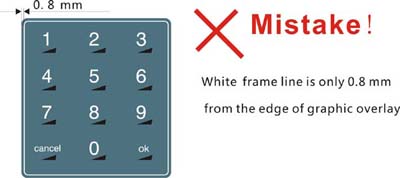
Mistake 2: The closed frame line is positioned less than 4 mm from the outer edge of the membrane.
Because the printing tooling has a positional tolerance of ±0.2 mm, a closed frame line cannot be reliably centered and is therefore not allowed. An interrupted line avoids this tolerance issue and is acceptable, as interrupted lines can be printed separately.
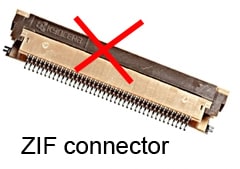
Mistake 3: Using a ZIF connector with a slip lock as the interface connector.
This can damage the silver circuit on the tail. The contact between the ZIF connector and the membrane switch’s silver tail will deteriorate quickly. This type of connector is only suitable for FPC (Flexible Printed Circuit) tails.
For the correct connector type for a membrane switch’s silver circuit tail, please refer to our design guide: https://www.sun-rising.cn/design-guide/